.jpg)
Inspection Methods
No-load rapid-acceleration exhaust smoke density test
- Scope: The test of smoke density in the exhaust of diesel-fueled vehicles at no loading and rapid acceleration.
- Definitions:
- Smoke density: the level of pollution, %, is according to CNS 9845 [Reflection Type Smokemeters for Diesel Automobiles]
- Rapid acceleration: refers to the action that the foot of driver is placed on the gas pedal to push the pedal all the way to the very end in a swift movement.
- Rpm at the maximum rated horsepower: the rpm occurred at the engine horsepower shown on the specification certificate of the diesel-fueled vehicle issued by the manufacturer.
- Test equipment:
- Reflection Type Smokemeter: as per CNS 9845.
- Filter paper: the properties of the filter paper used are according to Class E for quantitative analysis as specified in Type II, CNS 5038 [Filter Paper for Chemical Analysis].
- Timer: 0.1 second of resolution or finer.
- Engine rpm meter: for measurement of engine rpm, accuracy up to ± 50rpm.
- Vehicle conditions
- The engine of the vehicle tested shall be tuned to the manufacturer’s specification. The engine brake, if any, shall be turned off. Any device that may change the normal acceleration characteristics of the engine and suppress the effect of exhaust, or may affect the completion of test, shall be turned off.
- The vehicle tested shall be parked at a well-ventilated location, the gear placed at neutral, parking brake engaged, and air conditioning turned off.
- Slowly push the gas pedal to increase the engine rpm from idle. Continue the acceleration by pushing the gas pedal all the way to the very end if no inappropriate condition or noise is detected. For any possibility that the engine, equipment or people may be damaged or hurt, release the gas pedal immediately and abort the test.
- There shall not be any irregular leak in the exhaust system.
- The engine must be running at its normal conditions throughout the test. The temperatures of cooling water and oil shall be maintained within the normal range of working temperature specified by the manufacturer.
- The use of legal vehicle-grade diesel or the fuel appointed by the vehicle manufacturer available in the market is allowed, and the addition of fuel additive is prohibited.
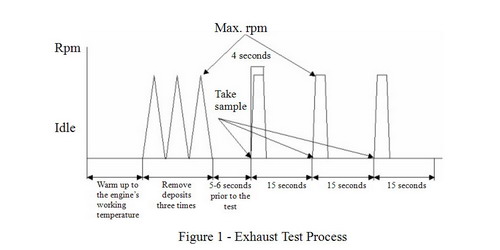
- Test method: the test process consists of warming up, deposit material removal and sampling, as shown in Figure 1.
- Warming up: the vehicle is properly warm up to the engine’s working temperature specified by the manufacturer.
- Deposit material removal: the gear of the vehicle tested shall be placed at neutral prior to the test. Accelerate rapidly and release the gas pedal. Repeat the cycle three times to remove the deposit material in the exhaust system. Record the maximum engine rpm of the three cycles, which should be greater than the rpm for the maximum rated horsepower.
- Sampling: the sample shall be taken in 5-6 seconds after the deposit material is removed.
- As the test starts, push the gas pedal hard and stay for 4 seconds, and then release the pedal immediately to return the engine back to idle for 11 second (15 seconds in total), thus completing a full test cycle. The sample is taken when the pedal is being pushed at the beginning of every test cycle.
- Repeat the test cycle 3 times until the difference between the smoke density readings is within 3% (level of pollution).
- The test report shall consists of:
- Manufacturer;
- Vehicle (engine) type;
- Vehicle model;
- Chassis or engine number;
- Vehicle’s gross weight;
- Rpm at the maximum rated horsepower;
- Total exhaust emission;
- Maximum engine rpm at each cycle; and
- Test result: the average taken from the three smoke density reading in V. 2. (2) is the test result.
Full-load constant-rpm exhaust smoke density test
- Scope: The test of smoke density in the exhaust of diesel-fueled vehicles at full loading and constant rpm.
- Definitions:
- Smoke density: the level of pollution, %, is according to CNS 9845 [Reflection Type Smokemeters for Diesel Automobiles]
- Full load: the running of engine at the preset rpm when the gas pedal is pushed to the very end.
- Maximum rated horsepower: the engine horsepower shown on the specification certificate of the diesel-fueled vehicle issued by the manufacturer.
- Rpm at the maximum rated horsepower: the rpm occurring at the engine horsepower shown on the specification certificate of the diesel-fueled vehicle issued by the manufacturer.
- Horsepower absorbed by the dynamometer: the vehicle’s horsepower output measured by the dynamometer.
- Test equipments:
- Reflection Type Smokemeter: as per CNS 9845.
- Filter paper: the properties of the filter paper used are according to Class E for quantitative analysis as specified in Type II, CNS 5038 [Filter Paper for Chemical Analysis].
- Dynamometer: it shall be capable of maintaining the vehicle at a constant speed and loading. When tested on the dynamometer, the vehicle shall have a secondary cooling fan to keep the temperature of the engine, cooling water and tires within the normal range.
- Engine rpm meter: for measurement of engine rpm, accuracy up to ± 50rpm.
- Thermometer: for measurement of ambient temperature with a resolution of 1°C.
- Barometer: for measurement of atmospheric pressure with a resolution of 0.1kPa.
- Vehicle conditions:
- The engine of the vehicle tested shall be tuned to the manufacturer’s specification. The engine brake, if any, shall be turned off. Any device that may change the normal acceleration characteristics of the engine and suppress the effect of exhaust, or may affect the completion of test, shall be turned off.
- The driving wheels of the tested vehicles shall park on the roller of the dynamometer. The vehicle shall be secured with wheel blocks, steel cable or other proper means. The secondary cooling is placed at the predetermined location, parking brake released, and air conditioning turned off.
- Slowly push the gas pedal to increase the engine rpm from idle. Continue the acceleration by pushing the gas pedal all the way to the very end if no inappropriate condition or noise is detected. For any possibility that the engine, equipment or people may be damaged or hurt, release the gas pedal immediately and abort the test.
- There shall not be any irregular leak in the exhaust system.
- The engine must be running at its normal conditions throughout the test. The temperatures of cooling water and oil shall be maintained within the normal range of working temperature specified by the manufacturer. In case that the heat dissipation is hindered, it is allowed to open the hood of the vehicle for better heat dissipation.
- The use of legal vehicle-grade diesel or the fuel appointed by the vehicle manufacturer available in the market is allowed, and the addition of fuel additive is prohibited.
- Test method:
- On the dynamometer, the vehicle is warmed up in the way specified by the manufacturer (or at the constant speed of 50km/h if not specified) to the engine’s normal working temperature before the test starts.
- Push the gas pedal to the very end. Set the following 3 test points according to the maximum rated horsepower of the engine. Select the proper gear for testing in sequence.
- 100% of that rpm ± 50rpm;
- 60% of that rpm ± 50rpm; and
- 40% of that rpm ± 50rpm
- Adjust the loading of dynamometer to the preset rpm. Take consecutive samples at each test point until the difference of the smoke density between the adjacent two records is less than 3% (level of pollution). Document the horsepower absorbed by the dynamometer at each test point. If the rpm is less than 1,000, the test rpm is taken as 1,000rpm ± 50rpm.
- When a diesel-fueled vehicle in use is being tested, the measured horsepower of the vehicle tested on the dynamometer at the test point at the rpm of 100% maximum rated horsepower shall not be less than 35% of the maximum rate horsepower. It is considered failing the test if the 35% mark is not reached.
- The vehicle that fails the test due to the horsepower ratio may return to the station for the next test only after 4 hours of the previous test.
- Test report:
the test report shall consists of:
- Manufacturer;
- Vehicle (engine) type;
- Vehicle model;
- Chassis or engine number;
- Vehicle’s gross weight;
- Maximum rated horsepower and rpm;
- Total exhaust emission;
- Ambient temperature and atmospheric pressure;
- Engine rpm at each test point and the horsepower absorbed by the dynamometer; and
- Test result:the average of the two smoke density readings are calculated, and taken as the test result after corrected for standard temperature (293°K) and air pressure (101.3kPa) with the following equation:
Corrected smoke density = smoke density taken from the test – 0.24(t-293) + 1.20(p-101.3)
Where t: temperature (°K) and p: air pressure (kPa)



TEL:00886-39-907548 FAX:00886-39-906795
Address: NO. 106, Ligong 2nd Rd. , Chengxing Village, Wujie Township,
Yi- Lan County, Taiwan(ROC)